Model Guides
911 vs 718: decal styles that suit each car
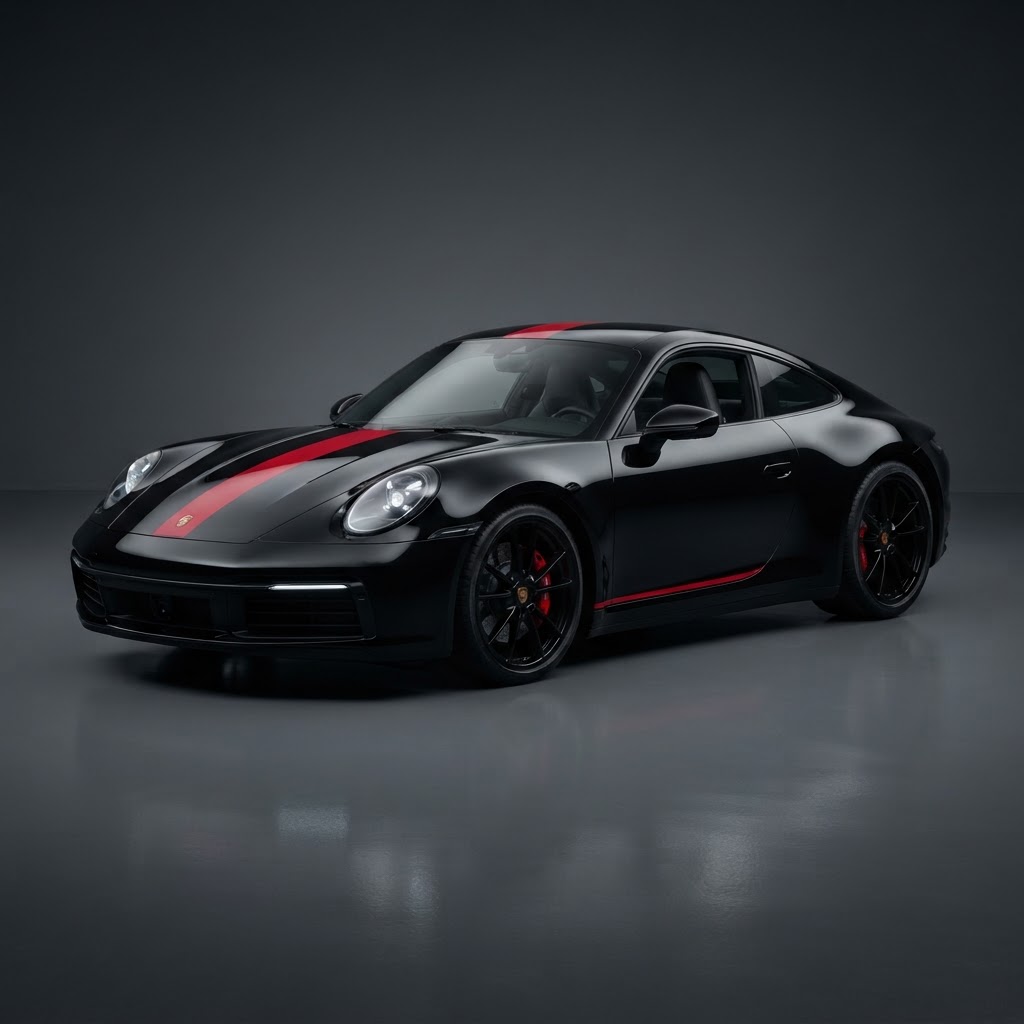
The 911 and the 718 are close relatives with quite different silhouettes, and that matters more for graphics than for almost any other modification. A decal follows the surface it is designed for: the length of the door, the height of the shoulder, the way the rear quarter swells over the wheel, the rake of the glass. Get the geometry right and a graphic looks like it was drawn onto the car. Get it wrong and it looks like a sticker applied to a panel.
This is a style guide, not a rulebook. But if you are choosing between designs, the differences below are the ones that decide whether a particular idea will work.
Proportions first
The 911 is the longer car, and its flank is comparatively flat and uninterrupted. The door is longer, the shoulder line runs at a shallower angle, and there is a generous area between the front wheel arch and the door shut. That gives a full-length side graphic room to establish a rhythm: a sweep that starts behind the front arch, passes through the door and resolves over the rear wheel.
The 718 is shorter and more compact, with a shorter door and a more pronounced haunch over the rear wheel. The shoulder turns earlier and more sharply. That shorter flat run changes what fits. A long sweeping graphic that would resolve gracefully on a 911 tends to get compressed on a 718, and the point where the design should ease out arrives before the panel has finished.
What suits a 911
Long side blades and sweeps
The 911's flank rewards a graphic with a long horizontal run. A side blade that follows the shoulder line, tapering towards the rear arch, uses the panel's length rather than fighting it. Our 911 GT3 side blade kit is built around exactly that proportion: a white sweep with a fine pinstripe, sized so the taper lands over the rear arch rather than stopping short of it.
Twin bonnet stripes
The 911 bonnet is long and its centre section is broad, which is why twin stripes work so well on it. Two parallel bands with a defined gap read as a considered motif; a single band can look like it was cut from a roll. Our twin stripe kit is an example of the pattern that suits this bonnet best, with the gap doing as much work as the stripes.
Roof and endplate details
On a 911 with a fixed rear wing, the roof panel and the wing endplates give you two surfaces that are visible from different angles. A graphic that appears on both, like our roof and endplate star kit, ties the rear of the car together in a way a single decal cannot.
What suits a 718
Compact motif side graphics
A 718 side graphic works better when it is shorter and more concentrated. Rather than spanning the whole flank, place the graphic between the door shut and the rear arch, or use a motif that sits deliberately within the door's length. The eye reads a shorter graphic on a shorter panel as intentional; a graphic that clearly wanted more room reads as compromised.
Accent rather than full-length
The 718's haunch does a lot of the visual work already. A graphic that competes with it, or crosses it at the wrong angle, flattens the shape the designers spent their time on. Accent pieces that sit below the shoulder, or that pick up the line of the sill, tend to work better than anything that runs across the haunch.
Sun strips and glass
Both cars take a sun strip well, because both have a generously curved screen and a low roofline. On the 718 the screen is more steeply raked, so a strip that is too deep will intrude on the driver's sightline sooner. A narrow band with a clean lower edge is the safer choice, and it is why sun strips are cut per model rather than sold in one universal depth.
Colour and finish by model
Finish choice changes how a graphic reads. A gloss film on a gloss car is subtle and relies on the design's shape; a matte film on the same car has visible contrast and reads as a deliberate addition. On a light car, a dark graphic gains impact from contrast alone; on a dark car, a light graphic often works better as a fine line than as a broad block. Our finish comparison covers how each surface finish behaves in daylight and under artificial light.
A note on heritage styles
Both models have long competition histories, and period-inspired graphics are popular for good reason: the proportions were worked out on the cars in the first place. If you are drawing on a period livery, the useful discipline is to check the original layout against your own panel lines rather than assuming a scaled-up version will land in the same place. Roundels belong where the panel is widest, stripes belong where the panel is straightest, and neither improves by being made larger than the space allows.
Practical fitment
Whatever style you choose, the kit has to match the generation, not just the model. A 992 and a 996 share a model number convention but nothing else about their panels, and the same is true across the 718 range. Use the fitment checker to confirm your model and year before ordering, and the installation guides for panel-level fitting detail.